Ikigai: The Japanese Secret to a Long and Happy Life

In a world that often measures success by job titles, income, and achievements, many of us can reach our goals yet still be left with a quiet, nagging question: “Is this all there is?” We chase happiness through fleeting pleasures but often neglect a deeper, more sustaining human need: purpose.
What if the secret to a long, joyful, and fulfilling life wasn’t about finding that one perfect job or achieving a single grand ambition? What if, instead, it was about finding a rich and balanced reason to get out of bed every morning?
The Japanese culture of Okinawa—one of the world’s “Blue Zones” renowned for the remarkable longevity and well-being of its people—offers a beautiful and profound answer to this search. They call it Ikigai (pronounced ee-key-guy).
Ikigai does not have a direct English translation. It is a concept that embodies the idea of having “a reason for being” or “the thing that you live for.” It’s not some mystical, unattainable destiny, but a practical and elegant framework for finding joy, meaning, and balance in your daily life. This guide will walk you through the philosophy of Ikigai and provide you with the four essential questions you need to answer to start uncovering your own.
The Four Overlapping Circles: Deconstructing Ikigai
The concept of Ikigai is beautifully represented by a Venn diagram of four overlapping circles. Your personal Ikigai is found at the center, where these four fundamental aspects of life converge. To find it, you must embark on a journey of self-exploration by asking yourself four powerful questions.
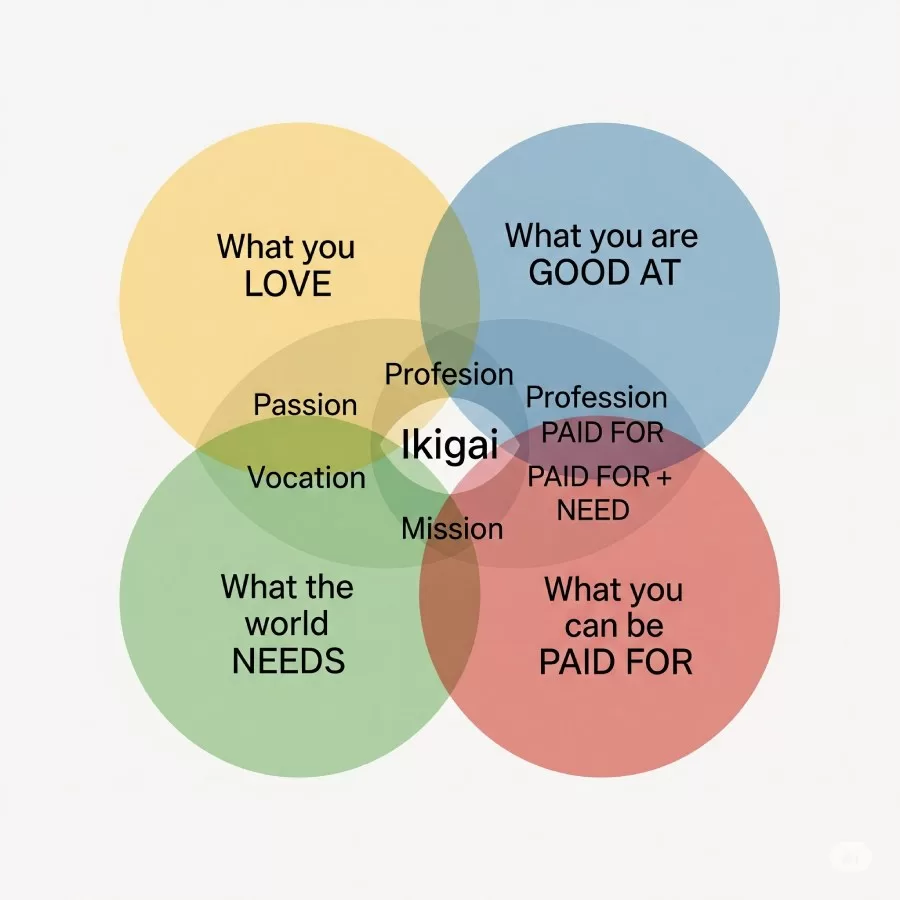
Circle 1: What Do You LOVE?
This is the realm of your passion, joy, and curiosity. It’s about what you would do even if no one was watching and no money was involved.
What activities make you lose all track of time?
What topics could you read, talk, or learn about for hours on end without getting bored?
What did you love to do as a child, before the world told you what was “practical” or “important”?
This circle is the heart of your Ikigai. Without love for what you do, even the most impressive career can feel empty.
Circle 2: What Are You GOOD AT?
This circle represents your skills, talents, and abilities—both those you were born with and those you have cultivated over time.
What comes more easily to you than it does to others?
What skills have you invested time and effort in developing, whether through education, work, or hobbies?
What do friends, family, or colleagues consistently ask for your help with?
This is the domain of your mastery. It’s where your natural gifts meet your dedicated efforts.
Circle 3: What Does the World NEED?
This is where your personal journey connects to a sense of service. It moves your focus from “me” to “we.” This doesn’t have to mean solving world hunger; it can be about meeting a need in your family, your local community, or your chosen field.
What problems in the world break your heart or fire you up?
What small (or large) change could you make that would benefit others?
If you could teach everyone in the world one thing, what would it be?
This circle provides a sense of meaning, the feeling that your life is contributing to something larger than yourself.
Circle 4: What Can You Be PAID FOR?
This final circle grounds your purpose in the practical reality of life. It’s about creating a sustainable existence where you are valued and rewarded for your contributions.
Which of your skills are in demand in the marketplace?
Is there a service or product related to your passions that people would be willing to pay for?
How could you turn what you’re good at into a profession, a business, or a side project?
This element ensures that your purpose can be sustained over the long term.
Finding the Sweet Spot: The Power of the Intersections
The true magic of the Ikigai model lies not just in the four circles, but in their intersections. Finding yourself in one of these overlapping zones can explain a lot about your current feelings of fulfillment (or lack thereof).
Passion (Loving it + Being good at it): You feel immense joy and mastery, but without serving a need or getting paid, you might feel a sense of uselessness.
Profession (Being good at it + Being paid for it): You are comfortable and financially secure, but if you don’t love it or feel it serves a purpose, you may feel empty and unfulfilled.
Vocation (Being paid for it + The world needing it): You feel a sense of purpose and financial stability, but if you aren’t particularly good at it or don’t love it, you might feel a sense of uncertainty or burnout.
Mission (The world needing it + Loving it): You feel a deep sense of meaning and delight, but without skills or financial reward, it may remain a dream or a volunteer activity.
Ikigai is the sweet spot in the center, a life where you are engaged in work you love and are good at, that serves a need in the world, and that can sustainably support you.
Purpose is a Pillar of a Truly Holistic Life

Uncovering your Ikigai provides a powerful compass for your life’s direction. This profound sense of purpose is a core pillar of spiritual well-being, but it becomes even more vibrant and sustainable when supported by a healthy body and a calm, resilient mind. True holistic living integrates them all.
Ikigai is a Journey, Not a Destination
It is important to release the pressure of finding your one, perfect Ikigai in a single afternoon of journaling. For most, it is not a sudden “aha!” moment, but a continuous process of exploration, discovery, and alignment. Your Ikigai can evolve and change as you move through different seasons of your life.
Your purpose may not be a grand, world-changing profession. It might be found in raising a compassionate family, creating a beautiful garden that brings joy to your neighborhood, mastering a craft, or being a deeply present and supportive friend.
Ikigai is not what you do, but how and why you do it. It is the simple, profound feeling of knowing your reason for being. The search itself is a worthy and joyful purpose.
A Gentle Reminder: Your health journey is beautifully unique. While we are passionate about providing supportive and educational content, please remember that the information in this article is for informational purposes only and is not a substitute for professional medical advice. Always consult your doctor before making significant changes to your diet or lifestyle.