Mindfulness for Beginners: A Simple Guide to Meditation

Where is your mind right now? Is it truly here, with these words on this page? Or is it replaying a conversation from yesterday, rehearsing a meeting for tomorrow, or planning your next meal? For most of us, most of the time, our minds are anywhere but here.
This state of constant mental chatter and time-traveling is what neuroscientists call the brain’s “default mode.” It is the source of much of our anxiety, rumination, and stress. We live our lives on autopilot, missing the richness of the only moment we ever truly have: the present.
But what if you could learn to gently guide your attention back to the here and now? What if you could relate to your thoughts and feelings with clarity and calm, rather than being controlled by them? This is not a superpower; it is a skill. It is the art of being present.
This guide is a deep dive into that art. We will move beyond simple “how-to’s” to explore the rich philosophy, the compelling science, and the transformative practices of mindfulness and meditation—the tools that allow you to move from a life of constant distraction to one of profound presence.
Mindfulness vs. Meditation: Understanding the Key Distinction
Though often used interchangeably, mindfulness and meditation are not the same thing. Understanding the difference is the first step in cultivating both.
Mindfulness: The State of Being
Mindfulness is a state of awareness. It is the practice of paying attention to the present moment—to your thoughts, feelings, bodily sensations, and surrounding environment—with an attitude of non-judgmental curiosity.
Think of it like turning on the lights in a room. You don’t necessarily change anything in the room, but you can suddenly see everything that’s there clearly. Mindfulness is the light of awareness that illuminates your inner world. You can practice it anywhere, anytime: while washing the dishes, walking your dog, or listening to a friend.
Meditation: The Formal Practice
Meditation is the formal training you undertake to strengthen your “mindfulness muscle.” It is the dedicated time you set aside to sit down and intentionally practice paying attention. Just as you go to the gym to build your physical muscles, you sit for meditation to build your capacity for focus, calm, and self-awareness. It is the “studio” where you hone the art of being present, so you can bring that skill into the rest of your life.
The Science of Presence: What Happens to Your Brain and Body
The benefits of mindfulness are not just philosophical; they are physical and measurable. Neuroscientists using fMRI technology have discovered that a consistent meditation practice can literally change the structure and function of your brain.
Taming the “Monkey Mind”: The Default Mode Network (DMN)
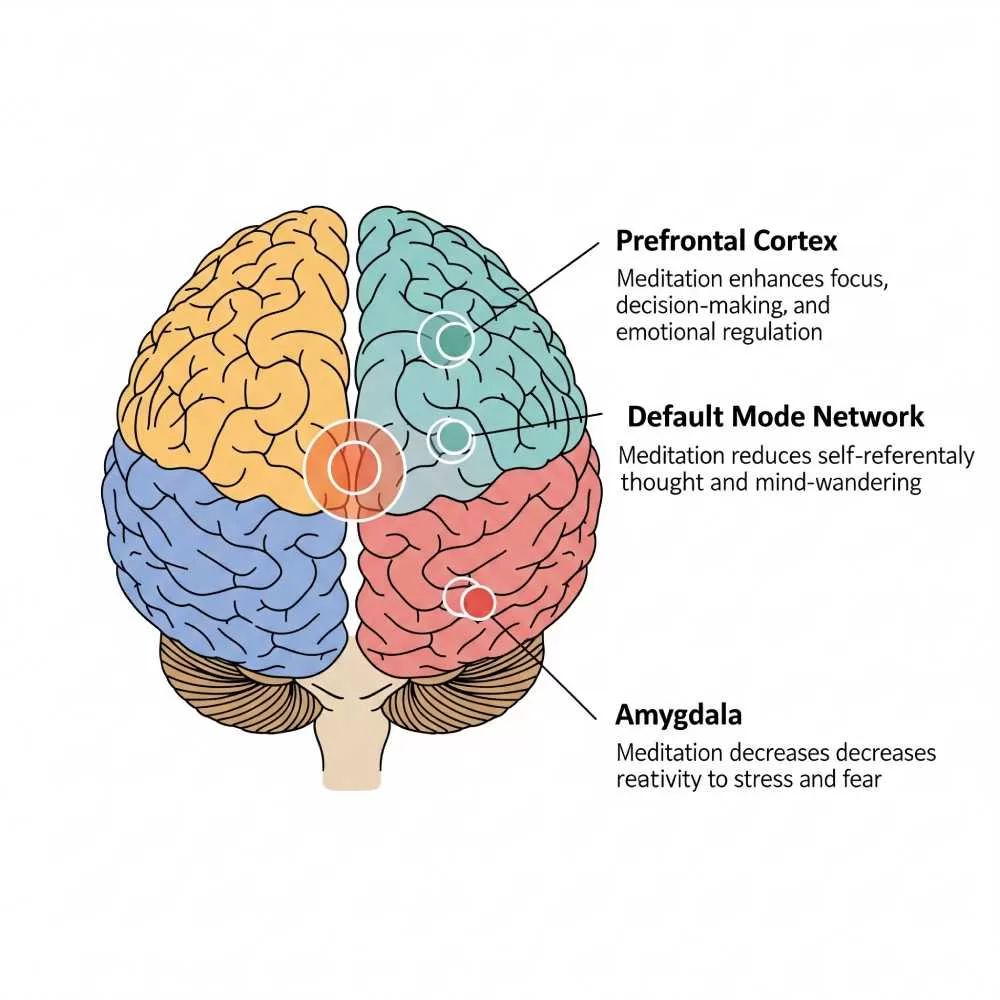
Your brain has a “wandering mind” circuit known as the Default Mode Network (DMN). This is active when you aren’t focused on a specific task—it’s the part of you that worries, daydreams, and ruminates. Research has linked an overactive DMN to unhappiness and anxiety. Meditation has been shown to decrease activity in the DMN, effectively “taming” the monkey mind and fostering a state of calm focus.
Strengthening Your “CEO”: The Prefrontal Cortex
The prefrontal cortex is the “CEO” of your brain, responsible for higher-order functions like focus, emotional regulation, and wise decision-making. Studies show that meditation can increase gray matter density in this crucial area, making it stronger and more effective.
Calming the Alarm System: The Amygdala
The amygdala is your brain’s ancient alarm system, constantly scanning for threats and triggering the “fight or flight” stress response. For many of us, this alarm is overly sensitive. Consistent mindfulness practice has been shown to reduce the gray matter density of the amygdala, making you less reactive to stress and more resilient in the face of challenges.
A Foundational Note: The Gut-Brain Connection to Presence
While these brain changes are profound, it’s important to remember the holistic principle of interconnection. A state of mental calm is deeply linked to a state of physical calm, especially in your gut. An inflamed or unbalanced gut can send stress signals to the brain, making it harder to calm the alarm system. Supporting your foundational gut health can therefore be a powerful way to support your mindfulness practice from the ground up. For those looking to establish this foundation, a high-quality synbiotic formula (containing both probiotics and prebiotics) can be a valuable ally on the journey.
The Practice Studio: Foundational Meditation Techniques
Ready to step into the studio? Here are three foundational techniques to begin your practice. Remember, the goal is not to achieve a “perfect” meditation, but simply to practice.
Technique 1: Focused Attention (The Breath Anchor)
This is the most classic and fundamental meditation practice.
1 – Find a comfortable seat where you can be undisturbed for a few minutes.
2 – Set a gentle timer for 5 or 10 minutes.
3 – Close your eyes and bring your attention to the physical sensation of your breath. Feel the coolness of the air as you inhale through your nose and the warmth as you exhale.
4 – Anchor your attention on this sensation. Your mind will wander. That is what minds do.
5 – When you notice your mind has wandered, gently and without judgment, acknowledge the thought (“thinking”) and then guide your attention back to your breath.
6 – Repeat this process—noticing the wandering and gently returning—until the timer goes off. The “returning” is the core of the practice.
Technique 2: The Body Scan Meditation
This practice is excellent for reconnecting with your physical self and releasing stored tension.
1 – Lie down comfortably on your back, with your arms resting by your sides.
2 – Bring your attention to the toes of your left foot. Notice any sensations—tingling, warmth, pressure—without needing to change them.
3 – Slowly, “scan” your awareness up your body, moving from your foot to your ankle, your calf, your knee, and so on, bringing a curious and kind attention to each part.
4 – Continue this all the way up your body to the crown of your head. This practice cultivates a deep sense of embodied presence.
Technique 3: Open Monitoring (Observing Thoughts)
This is a slightly more advanced practice. Instead of anchoring on the breath, you allow your awareness to be open to whatever arises in your consciousness—thoughts, feelings, sounds—without latching onto any of it.
Imagine you are sitting on the bank of a river. Your thoughts and feelings are like leaves floating by on the current. Your job is not to jump into the river and chase the leaves, but simply to sit on the bank and watch them come and go. This practice builds the powerful skill of dis-identifying from your thoughts.
Presence is a Pillar, Not the Whole Temple

Mastering the art of being present will fundamentally transform your mental world. But true, lasting well-being emerges when this calm, clear mind is housed in a nourished body and guided by a purposeful spirit. Mindfulness is a core pillar, but it is most powerful when built as part of a complete, holistic life.
Your Life Is a Collection of Present Moments
The art of being present is not about adding another strenuous task to your to-do list. It is about subtracting the habit of distraction to reveal the richness, beauty, and peace that is already here, in this moment.
Your entire life unfolds in a series of “nows.” They are all you ever truly have. By learning to inhabit them fully, with awareness and an open heart, you don’t just change your moments—you change your life.
What is one small way you can practice being present today? Share your intention in the comments below.
A Gentle Reminder: Your health journey is beautifully unique. While we are passionate about providing supportive and educational content, please remember that the information in this article is for informational purposes only and is not a substitute for professional medical advice. Always consult your doctor before making significant changes to your diet or lifestyle.